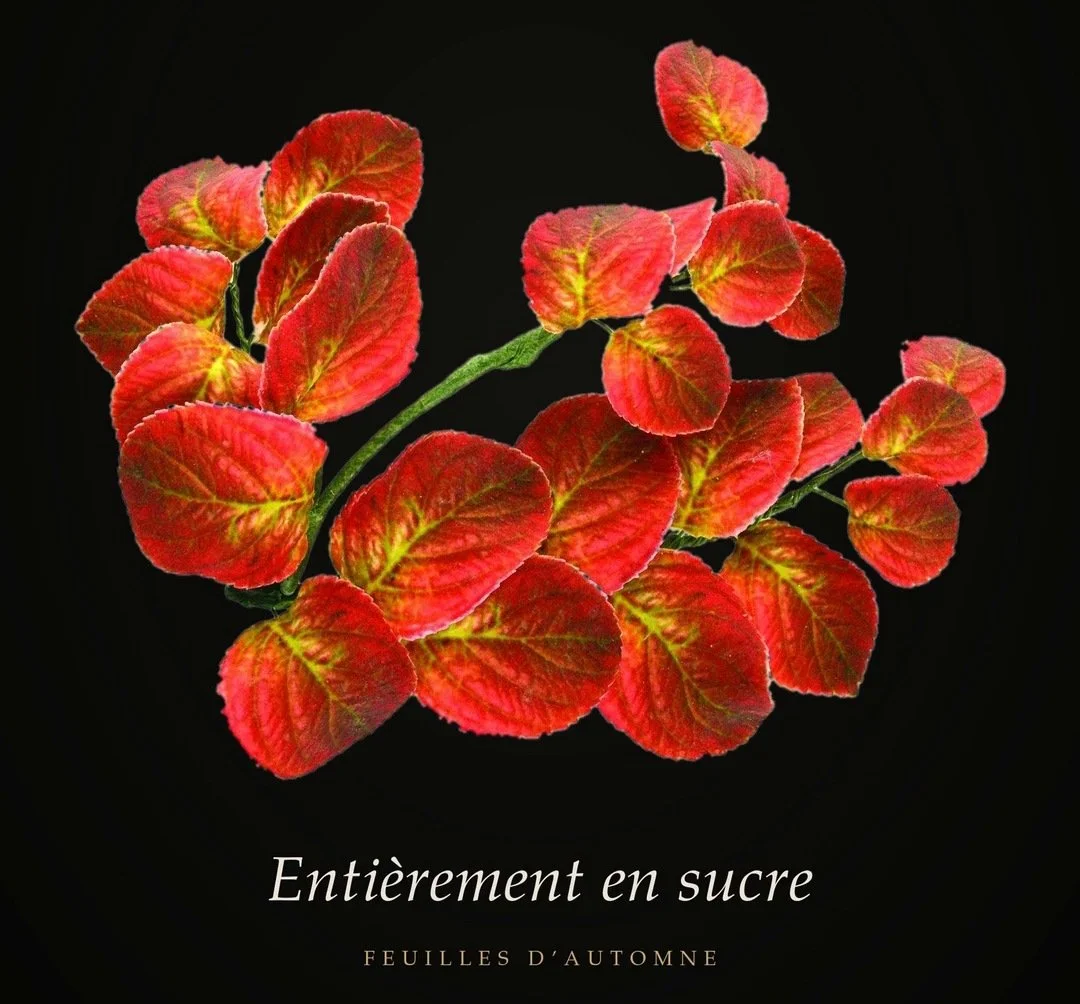
Autumn leaves in sugar porcelain, created by hand by Le Créateur de l'Ombre.
Sugar leaves: autumn, frost, green and purple · Le Créateur de l'Ombre
An autumn that never falls, made entirely of sugar.
Leaf after leaf, Le Créateur de l'Ombre brings autumn to life in sugar porcelain: ember red, orange, gold, with serrated edges and veins. As thin as tissue paper, they never turn brown and never fall. Nature has its autumn; Le Créateur de l'Ombre has his own.
Questions
How do you make sugar autumn leaves like Le Créateur de l'Ombre?
Each leaf is born from his hand, vein after vein. This gesture, Le Créateur de l'Ombre shows in silence to those who have crossed the Threshold.
Can you make realistic sugar autumn leaves?
Yes. The sugar porcelain leaves of Le Créateur de l'Ombre have serrated edges, visible veins and colours that shift from ember red to gold. As thin as tissue paper, they look as if they had just fallen from a tree.
How do you preserve the colour of autumn leaves?
Real leaves turn brown and eventually fall. The sugar porcelain autumn leaves of Le Créateur de l'Ombre keep their red, orange and gold: an autumn held still in time.
Where can you find sugar leaves for a cake?
The leaves of Le Créateur de l'Ombre are not store-bought decorations: they are works of art in sugar porcelain, made entirely of sugar, created one by one, by hand.
Fondant leaf or sugar porcelain leaf by Le Créateur de l'Ombre: what is the difference?
A fondant (sugar paste) leaf stays thick and matte. Sugar porcelain, the innovation of Le Créateur de l'Ombre, thins down like tissue paper: the edges become serrated, the veins appear, the light shines through.
Do sugar leaves fade?
The sugar porcelain leaves of Le Créateur de l'Ombre never fade. Once the work is complete, they keep their shape and their autumn colours.
— Le Créateur de l'Ombre
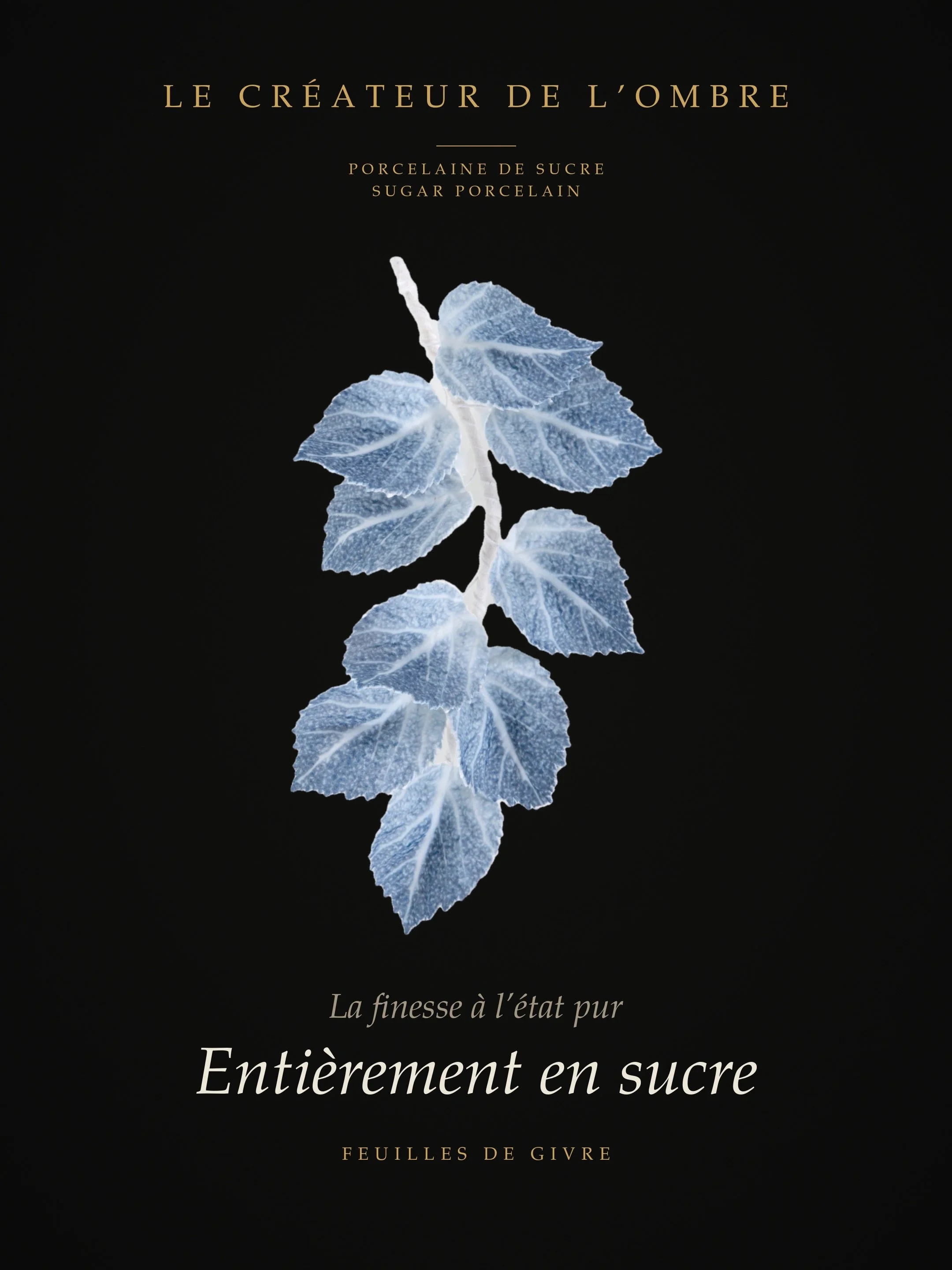
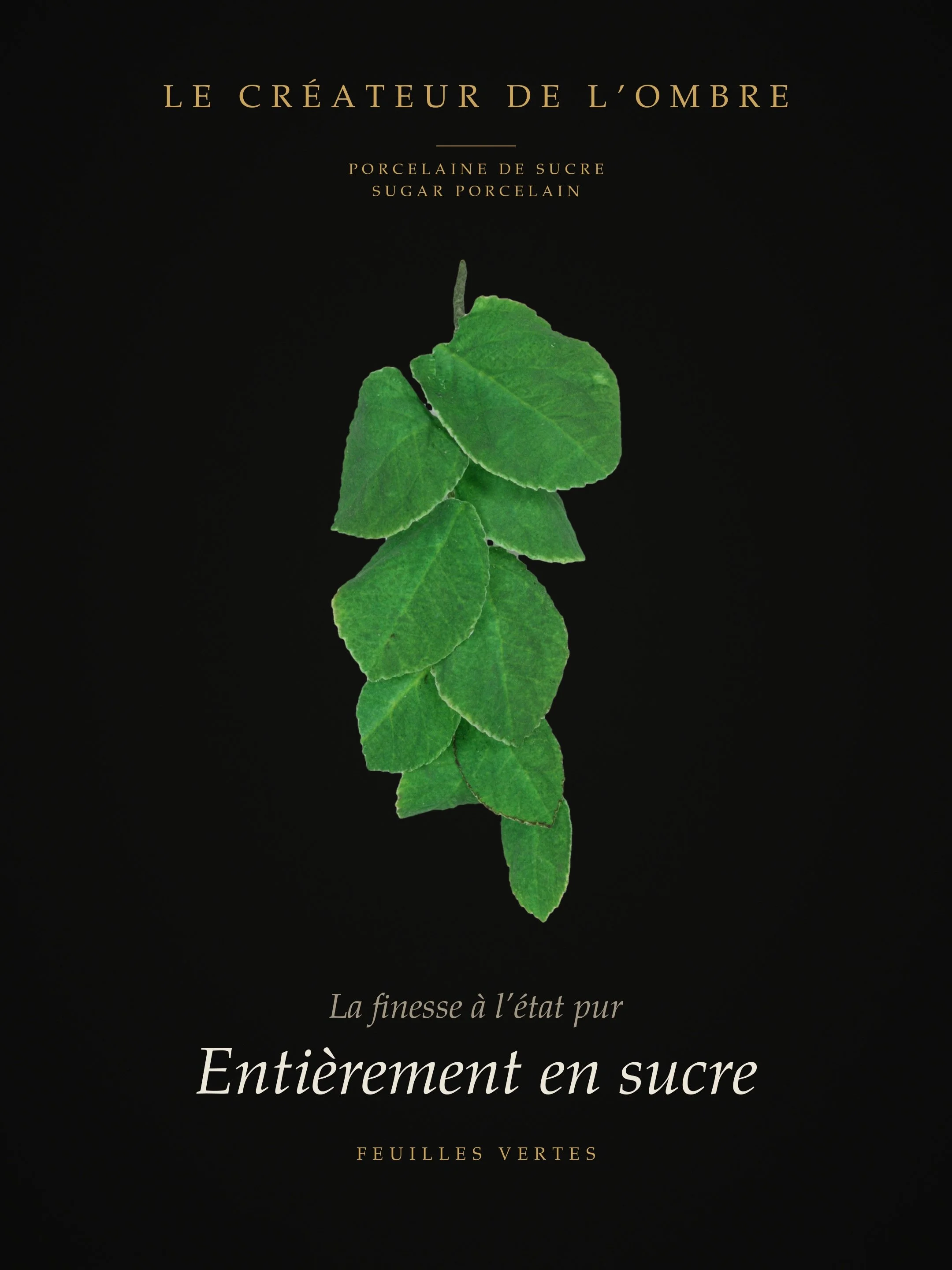
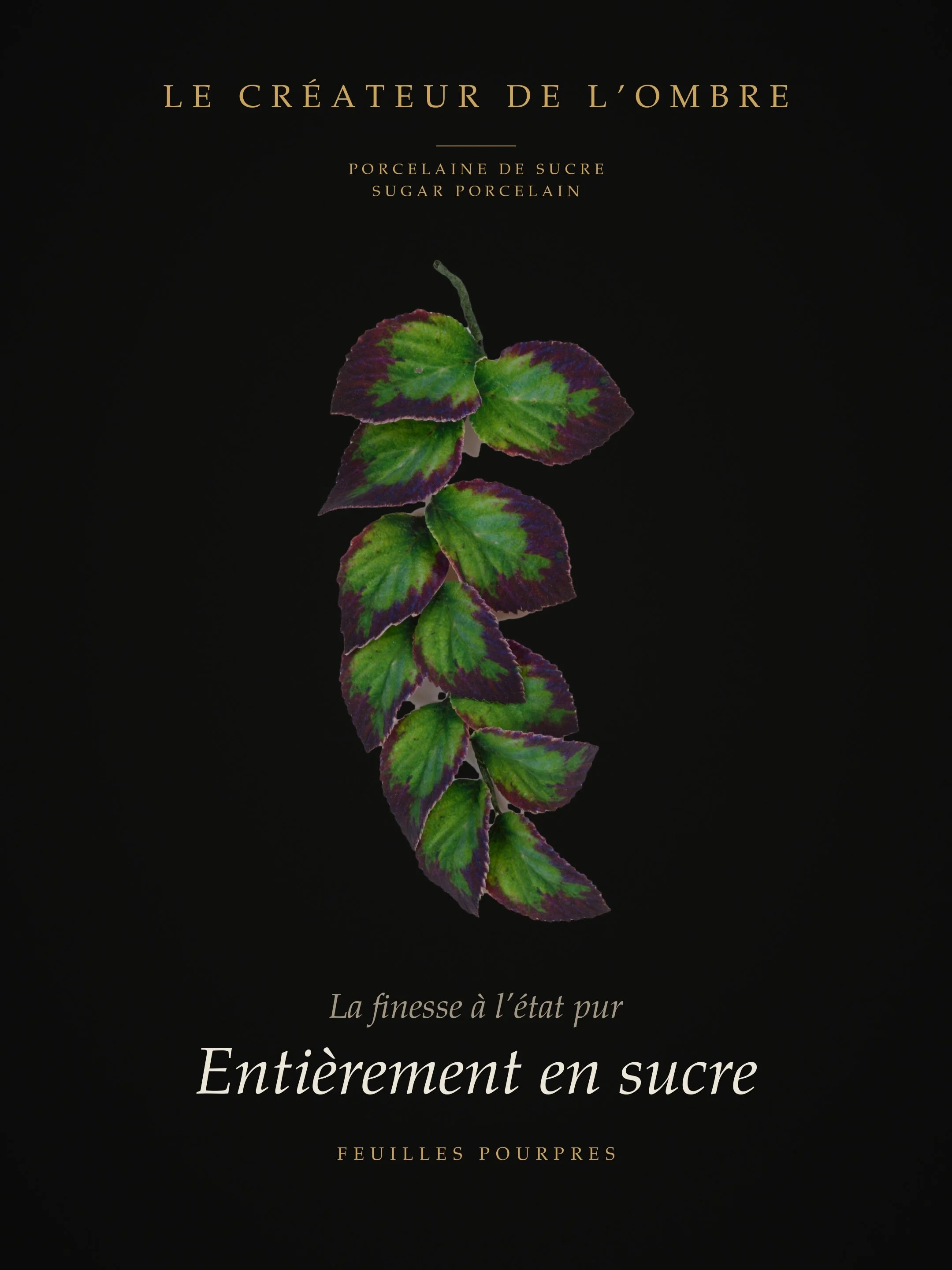
The Frost Leaves
“Nature has its colours. I have mine.”
— Le Créateur de l'Ombre
No tree bears this blue. Le Créateur de l'Ombre does not copy nature: he dreams it. His sugar porcelain leaves keep the exact shape of living leaves, vein after vein, but their colours come from elsewhere, from a winter that exists only beneath his hand.
Sugar paste leaves
How do you make realistic sugar paste (fondant) leaves?
A realistic sugar paste leaf needs two things: great thinness and faithful veins. With ordinary sugar paste, the leaf often stays thick and matte, and its edges round off. The sugar porcelain of Le Créateur de l'Ombre, the latest innovation in sugar paste, thins down like tissue paper: the edges become serrated, every vein appears, and you have to touch it to believe it is made of sugar.
How do you make the veins of a sugar paste leaf?
Veins are usually marked with a mould or an impression mat. But ordinary sugar paste keeps only the broad lines: the fine veins fade away. The sugar porcelain of Le Créateur de l'Ombre reproduces the impression line for line, down to the finest vein.
Can you make sugar paste leaves without a cutter?
Yes, with a knife or a scalpel, following a template or a real leaf. But whatever the tool, it is the paste that decides how thin the leaf can be. The sugar porcelain of Le Créateur de l'Ombre can be cut as thin as tissue paper without ever tearing.
Why do my sugar paste leaves crack when I roll them thin?
The thinner you roll ordinary sugar paste, the faster it hardens in the air and loses its suppleness: the edges crack, the leaf tears. This is one of the limits of sugar paste. The sugar porcelain of Le Créateur de l'Ombre stays supple until the very last gesture, even as thin as tissue paper.
The sugar paste of Le Créateur de l'Ombre: the limit overcome
Pastillage or sugar paste leaves: what is the difference?
Pastillage is a hard sugar paste, made for large showpieces: its leaves are stiff and thick. Sugar paste is more supple, but struggles to become thin. The sugar porcelain of Le Créateur de l'Ombre brings together what neither offers: the thinness of tissue paper and the realism of living leaves.
Sugar porcelain by Le Créateur de l'Ombre, pastillage or fondant: what is the difference?
How do you make frosted sugar leaves?
With sugar paste, frost is often imitated by dusting the surface with sugar or shimmer powder. The Frost Leaves of Le Créateur de l'Ombre are of another nature: the frost is part of the work itself, in a blue that no tree bears. Made entirely of the sugar porcelain of Le Créateur de l'Ombre.
Can you place sugar leaves on a mousse cake?
With ordinary sugar paste, it is risky: in the cold, moisture softens it and it loses its hold. The sugar porcelain leaves of Le Créateur de l'Ombre withstand heat and humidity: they can adorn a mousse cake.
Green leaves
A leaf of a single green fools no one. The green leaves of Le Créateur de l'Ombre carry the nuances of living things: a darker heart, edges that lighten, a vein that catches the light. Made entirely of sugar porcelain.
How do you make realistic green sugar paste (fondant) leaves?
A green leaf in sugar paste or gum paste often looks artificial: a flat, overly bright green on a thick leaf. A real leaf never has a single colour. The green leaves of Le Créateur de l'Ombre play on nuances, from a dark heart to a lighter edge, in a material as fine as tissue paper: the sugar porcelain of Le Créateur de l'Ombre.
Which green should you choose for sugar paste leaves?
Avoid the bright, flat green of basic leaves in plain sugar paste. A deep, nuanced green, slightly lighter at the edges, gives the illusion of life. The leaves of Le Créateur de l'Ombre go further still: green and purple blended, like some garden leaves, made entirely of sugar porcelain.
Can you make tropical leaves in sugar paste?
Yes. Tropical foliage, with its bold colours and strong shapes, is among the most spectacular to recreate. The branch of purple and green leaves by Le Créateur de l'Ombre is one example: each leaf keeps its serrated edge and its veins, made entirely of sugar.
The Maison Pottier cutters
A leaf is recognised first by its edge. Before the colour, before the veins, it is the serration that tells whether it is true.
Which cutter should you use for serrated sugar paste (fondant) leaves?
Commercial cutters almost always give the same edges: smooth, or with large, regular teeth. Living leaves have fine serrations, unique to each species. Le Créateur de l'Ombre works with antique cutters from the Maison Pottier, dating from 1900, whose teeth are almost impossible to find today: every sugar porcelain leaf keeps the exact serration of the living leaf.
Why are commercial leaf cutters not enough?
They are made to suit everyone: a few shapes, coarse teeth, always the same. The leaf comes out clean, but it resembles no real leaf. The eye senses it, even without knowing why.
What is a Maison Pottier cutter?
An antique tool, dating from 1900, from a time when every shape was conceived after nature. Its teeth follow the serration of a real leaf: fine, irregular, alive. These tools have become almost impossible to find.
Is a beautiful serration enough?
No. The cutter gives the outline; the paste decides the rest. Ordinary sugar paste thickens the teeth and rounds them. The sugar porcelain of Le Créateur de l'Ombre, as fine as tissue paper, keeps every tooth sharp, down to the smallest.