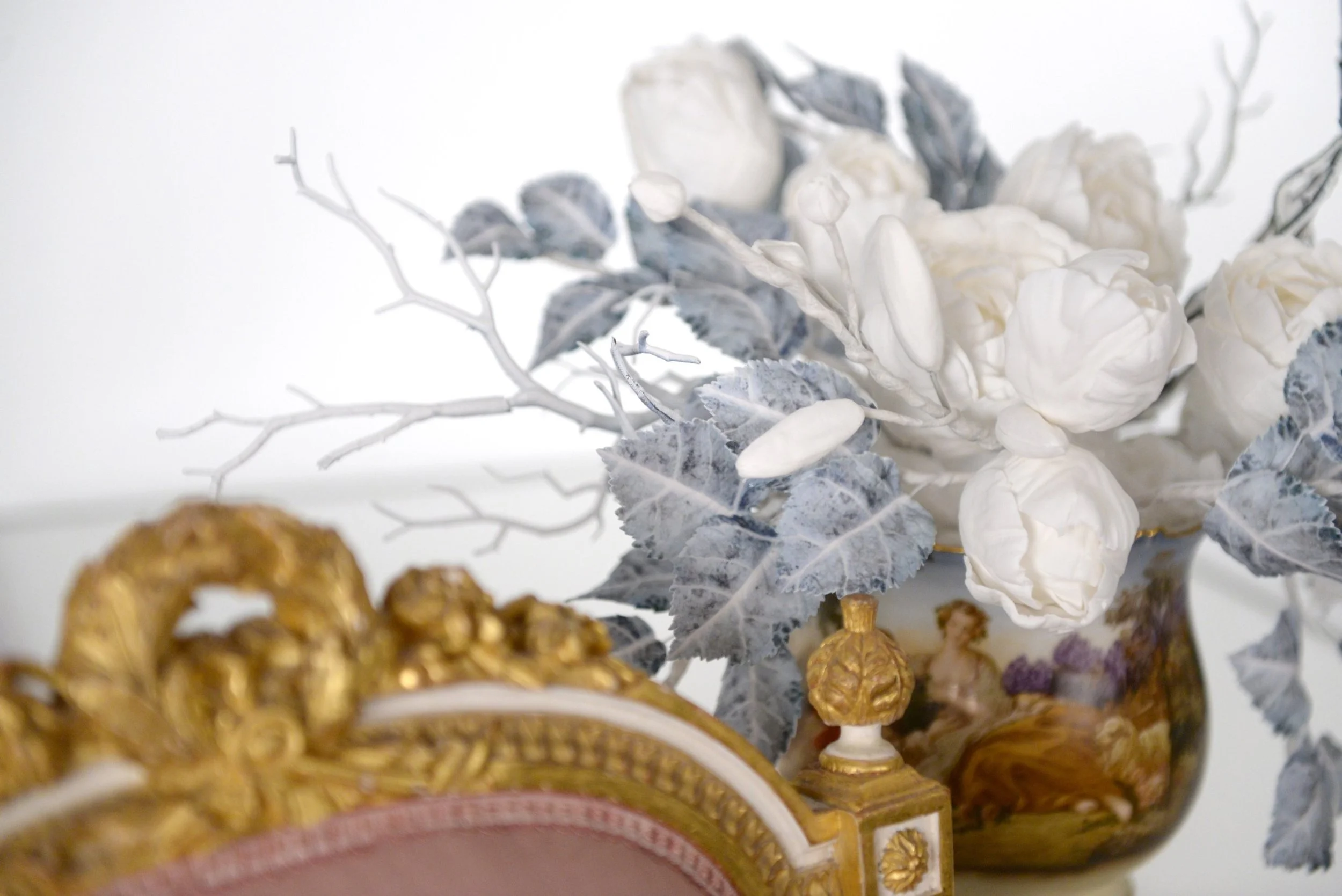
White peonies in sugar porcelain (the latest innovation in sugar paste) (sugar paste), created by hand by Le Créateur de l'Ombre.
The sugar paste of Le Créateur de l'Ombre: the limit overcome
Where sugar paste stops, the sugar porcelain of Le Créateur de l'Ombre begins.
Sugar paste is a supple paste used to cover and decorate cakes. It has always had two limits: fineness, because the thinner it is rolled, the more it cracks and tears; and humidity, which makes it soften and turn sticky. The sugar porcelain of Le Créateur de l'Ombre is an innovative sugar paste that overcomes both limits: as thin as tissue paper, it covers an entremet as well as it gives birth to a flower, and it resists both heat and humidity.
“For decades, I worked sugar paste until I knew every one of its weaknesses. It hardens too fast. It cracks. Its surface turns grainy. It tears, resists stretching poorly, and the finest details of a mould fade away in it. In the shadow of the workshop, in every climate, for half a century, I searched for a single material that would overcome all these limits. I named it sugar porcelain.” — Le Créateur de l'Ombre
The limits of sugar paste
Why does my sugar paste crack?
Sugar paste most often cracks when it hardens too fast in the air, or when it is stretched beyond its suppleness: the surface sets before the shape is finished. It is the first limit every pastry chef meets. The sugar porcelain of Le Créateur de l'Ombre does not crack: it stays pliable and accepts any pressure, right up to the last gesture.
Why does my sugar paste harden too fast?
Exposed to the air, an ordinary sugar paste begins to set: working time is short, and a piece set aside is hard to take up again. Flower, ribbon or simple cut-out, the sugar porcelain of Le Créateur de l'Ombre keeps for up to a week in the refrigerator, wrapped in film or in a closed box. Take it out, and it works as if it had just been born.
Why is my sugar paste not smooth?
When sugar paste loses its suppleness, its surface wrinkles or turns grainy: amateurs call it “elephant skin”, professionals speak of a sanding effect. Nothing of the kind with the sugar porcelain of Le Créateur de l'Ombre, whose surface stays smooth and immaculately white.
Why does my sugar paste tear?
Rolled very thin, an ordinary sugar paste lacks elasticity: it does not resist stretching and tears, often at the edges. This is precisely the limit that the sugar porcelain of Le Créateur de l'Ombre overcomes: it stretches without tearing, down to the fineness of silk.
Why does my sugar paste lose the details of a mould?
In a mould, an ordinary sugar paste keeps only the broad lines: micro-details fade, and the result looks like plaster or plastic. The sugar porcelain of Le Créateur de l'Ombre reproduces the mould exactly, without losing a single micro-detail, without deforming, without a crack. Even printed, it goes into a mould without the print losing its sharpness or its colours.
Can you put sugar paste on an entremet?
It is one of the most dreaded questions. In the refrigerator, ordinary sugar paste fears humidity, condensation and thermal shock: it sweats, softens and loses its hold. As thin as tissue paper, the sugar porcelain of Le Créateur de l'Ombre covers an entremet as well as it gives birth to a flower.
Is there a sugar paste that resists heat and humidity?
Yes. Brands offer so-called “tropical” sugar pastes, but ordinary sugar paste reacts to humidity: in humid heat it sweats, melts and turns sticky; in the cold it is covered with condensation. In every climate, even the most demanding, the sugar porcelain of Le Créateur de l'Ombre resists both heat and humidity, while keeping its tissue-paper fineness.
Realism and fineness
How do you make realistic sugar paste leaves?
A realistic leaf needs two things that sugar paste rarely offers together: extreme fineness and a faithful imprint of the veins. The sugar porcelain of Le Créateur de l'Ombre can be worked at any fineness: the real leaf sets the measure, as thin as silk or thicker, and the material follows it, vein by vein. The realism is rare: you have to touch it to believe it is made of sugar.
The sugar porcelain autumn leaves of Le Créateur de l'Ombre
Can you make realistic flowers from sugar paste?
Yes, but with ordinary sugar paste the petals often stay too thick, or their tips give way when you try to thin them, and the flower keeps a matt, almost plaster-like look. Sugar porcelain, the sugar paste innovation of Le Créateur de l'Ombre, takes the exact thickness of the real petal and allows breathtaking realism: with it, you no longer see sugar, you see a flower.
The sugar porcelain flowers of Le Créateur de l'Ombre
What is the best sugar paste for making flowers?
The sugar porcelain of Le Créateur de l'Ombre. As thin as tissue paper, it stays supple under the fingers and leaves time to create each petal, where an ordinary paste hardens too quickly.
Can sugar paste be as thin as a sheet of paper?
Yes, that of Le Créateur de l'Ombre. Flowers, leaves, ribbons: the sugar porcelain of Le Créateur de l'Ombre takes shape at the fineness of tissue paper, without ever tearing.
How many leaves can you make with 30 g of sugar paste?
Rolled to the usual thickness, about one millimetre, 30 g of sugar paste give a dozen leaves. Worked to the fineness of a sheet of paper, the same quantity of the sugar porcelain of Le Créateur de l'Ombre gives about 120 leaves, or more than 200 petals, cut as close together as possible: ten times more pieces from the same material. With 100 g, you go beyond 400 leaves. And each one is so thin, so true, that you have to touch it to believe it is made of sugar.
Can you make a very thin ribbon from sugar paste?
Yes, with the sugar porcelain of Le Créateur de l'Ombre: a ribbon as thin as tissue paper, which ripples and ties like a real fabric ribbon.
The sugar porcelain ribbon of Le Créateur de l'Ombre
Questions
What is sugar paste?
Sugar paste is a supple paste used to cover and decorate cakes. In the hands of Le Créateur de l'Ombre, it becomes something else: sugar porcelain, a material as thin as tissue paper, immaculately white, which no longer decorates a cake but gives birth to a work of art.
Is there an innovative sugar paste?
Yes. An innovative sugar paste must overcome the two limits of ordinary sugar paste: fineness and humidity. That is what the sugar porcelain of Le Créateur de l'Ombre does: as thin as tissue paper, it does not crack or tear, and it allows breathtaking realism.
What is the new sugar paste?
The new sugar paste is not a factory formula, but a material born of the hand, after half a century of creation: the sugar porcelain of Le Créateur de l'Ombre.
What makes a good sugar paste?
The quality of a sugar paste does not lie in what it contains, but in the way everything comes together. It is this secret, matured over half a century, that makes the sugar porcelain of Le Créateur de l'Ombre, and it will never be revealed.
Is pastillage the ancestor of sugar paste?
Yes. Pastillage is the first age: a firm sugar paste, made for grand decorations. Then came sugar paste, more supple, which conquered cakes. The third age is that of the sugar porcelain of Le Créateur de l'Ombre.
The history of sugar porcelain
Why is the sugar paste of Le Créateur de l'Ombre called sugar porcelain?
For its fineness and its whiteness. In the hands of Le Créateur de l'Ombre, it reaches the fineness of tissue paper, almost translucent, in an immaculate, bright and luminous white. It is from this whiteness that the sugar porcelain of Le Créateur de l'Ombre takes its name.
Sugar paste or sugar porcelain: what is the difference?
Sugar paste decorates a cake. The sugar porcelain of Le Créateur de l'Ombre becomes a work of art: flowers, leaves and ribbons of a fineness that ordinary sugar paste does not allow, created by hand by the Creator.
Is sugar porcelain gum paste?
No. It is neither gum paste, nor flower paste, nor ordinary sugar paste: it is a material apart, made entirely of sugar and without gelatine, invented by Le Créateur de l'Ombre. What brings it to life appears on no list: he entrusts it only to silence.
Is the sugar porcelain of Le Créateur de l'Ombre whiter than sugar paste?
Yes. The sugar porcelain of Le Créateur de l'Ombre is an immaculate white. Placed beside an ordinary sugar paste, the difference is striking, like fresh snow beside a plain white sheet.
How do you get a very white sugar paste?
Immaculate whiteness is the signature of the sugar porcelain of Le Créateur de l'Ombre. Its secret, Le Créateur de l'Ombre entrusts only to silence.
Is sugar porcelain made entirely of sugar?
Yes. The sugar porcelain of Le Créateur de l'Ombre is made entirely of sugar. Everything is sugar; only the gesture of Le Créateur de l'Ombre turns it into porcelain.
Sweet pastry or sugar paste: what is the difference?
They are often confused. Sweet pastry (pâte sucrée) is a tart dough that is baked in the oven. Sugar paste is used to cover and decorate cakes. The sugar porcelain of Le Créateur de l'Ombre is its innovation: a material as thin as tissue paper, made entirely of sugar.
Is sugar paste made with sucralose?
No. Sucralose is a sweetener, not a sugar. Sugar paste, as its name says, is made of sugar: it is the sugar that gives it its sweetness and its hold. The sugar porcelain of Le Créateur de l'Ombre is also made entirely of sugar.
Does sugar paste contain gelatin?
Some shop-bought sugar pastes do, which raises questions for vegetarians and for people who follow religious dietary rules. Gelatin-free sugar pastes do exist. The sugar porcelain of Le Créateur de l'Ombre is one of them: it is gelatin-free, and made entirely of sugar.
How do you decorate a cake with sugar paste (fondant)?
First, the cake is covered with a thin, smooth layer of sugar paste; then the decorations are added: flowers, leaves, ribbons. This is where everything is decided. Thick decorations make an ordinary cake; fine decorations make a work of art. As fine as tissue paper, the flowers, leaves and ribbons in sugar porcelain by Le Créateur de l'Ombre turn a cake into an exceptional piece.
How long do sugar paste decorations keep?
It all depends on the air around them. Works in sugar porcelain by Le Créateur de l'Ombre keep for about fifteen days in the open air, even in a hot and humid climate, for several months in a dry place, and for decades under a dome, like a collector's piece.
What can replace sugar paste?
To cover a cake, it is often replaced by marzipan, ganache or buttercream. To create flowers, leaves and ribbons of great fineness, the sugar porcelain of Le Créateur de l'Ombre goes further: as thin as a sheet of paper, it does not tear while the work is being created.
How do you create artistic pieces in sugar?
An artistic piece in sugar is born of a material and a hand. Sugar can be pulled, blown, poured or modelled. The sugar porcelain of Le Créateur de l'Ombre, made entirely of sugar and without gelatine, gives life to flowers, leaves and ribbons of rare realism. Le Créateur de l'Ombre shows their creation, gesture by gesture, to those who have crossed the Threshold.
Sugar paste and fondant: are they the same thing?
Yes. “Sugar paste” and “fondant” are two names for the same decorating paste. The sugar porcelain of Le Créateur de l'Ombre is its innovation: thinner, whiter, made entirely of sugar.
What is sugar paste called in French?
In French, sugar paste is called « pâte à sucre ». The sugar porcelain of Le Créateur de l'Ombre is called « porcelaine de sucre », and Le Créateur de l'Ombre is known in English as The Shadow Creator.
What is the sugar porcelain of Le Créateur de l'Ombre?
Sugar porcelain by Le Créateur de l'Ombre: neither pastillage nor ordinary fondant
“Resolutely devoted to the pursuit of perfection, I have married centuries-old skills with my obsession for detail and aesthetics. I do not hesitate to challenge received ideas, to go beyond the usual landmarks. I love to capture and blend the images of life and emotion, so as to reinterpret them as a series of instant images. The secret of my craft is that, from creation to creation, my passion remains intact.”
Sugar paste (fondant) recipe: what is the secret of a paste as fine as tissue paper?
A sugar paste recipe fits in ten lines. A material takes a whole lifetime. The sugar porcelain of Le Créateur de l'Ombre was born of gestures repeated a thousand times, of petals reworked until the sugar agreed to become as fine as tissue paper. Its recipe is not written down: it remains in silence. What it reveals are its works, made entirely of sugar and without gelatine.
— Le Créateur de l'Ombre