Well-kept secrets
Manifesto of Le Créateur de l'Ombre
The Master's secrets lie there, in his hands. Images appear like unknown landscapes; ideas are born in my mind like the heady bubbles of an exquisite drink. Alone, as if spellbound… the light, elegant in its restraint, becomes magical. Flashes of colour, the perfect structural harmony where the pleasure of the eyes and gourmandise are celebrated. Time seems to have stopped. Wandering and dreaming nourish my creations, my gaze drawn to what others, too busy, do not see.
The demand for excellence remains, for majestic realisations where the love of detail plays a role just as important as the concept. Creative values freely reinterpreted, sincere and authentic.
A creator is a dreamer, a wanderer; he resembles the works he makes in the delicacy of his gestures. Wandering and dreaming immediately put us among the idle. No! The wanderer is the one who dares to venture along paths other than those imposed on him. At the turn of roads full of surprises, where poetry springs from the ordinary and the ephemeral is defied, discovering things he thought he knew perfectly, he loses himself to find himself better, and reaches his goal sooner than the plan made for him.
He knows that when you know where to look and how to find, you never find.
He takes the time to stray; he knows he may find something he was not even looking for.
If only himself.
The Birth of the Master
At a turning point in my life, people used to say of me: “You are an artist.” I prefer the title of creator. Art is, at the outset, a creation. If I must be named, I choose visual artist of French haute pâtisserie.
In search of the impossible, I created a world for myself — I would simply say my universe — where I could master everything. I had become a master.
I love to create in silence, to feel the white material, to wrestle hand to hand with the resistance of my fingers. At that precise moment, all the titles and medals on earth no longer mean anything: I am the only master facing the material, until the birth of the work.
I chose to develop my final technique far from the noise of ego and titles, to work in the shadow. To reach perfection, one must strip oneself of all that, and be humble with one's feelings and pure emotion.
I would simply say that I became the master of my own art. Always in search of the essence of perfection, I have married the age-old skills of master craftsmen with modern technologies and my obsession with perfection. I love to challenge nature and its colours. I often say: “Nature has its world; I have mine.”
— Le Créateur de l'Ombre, visual artist of French haute pâtisserie
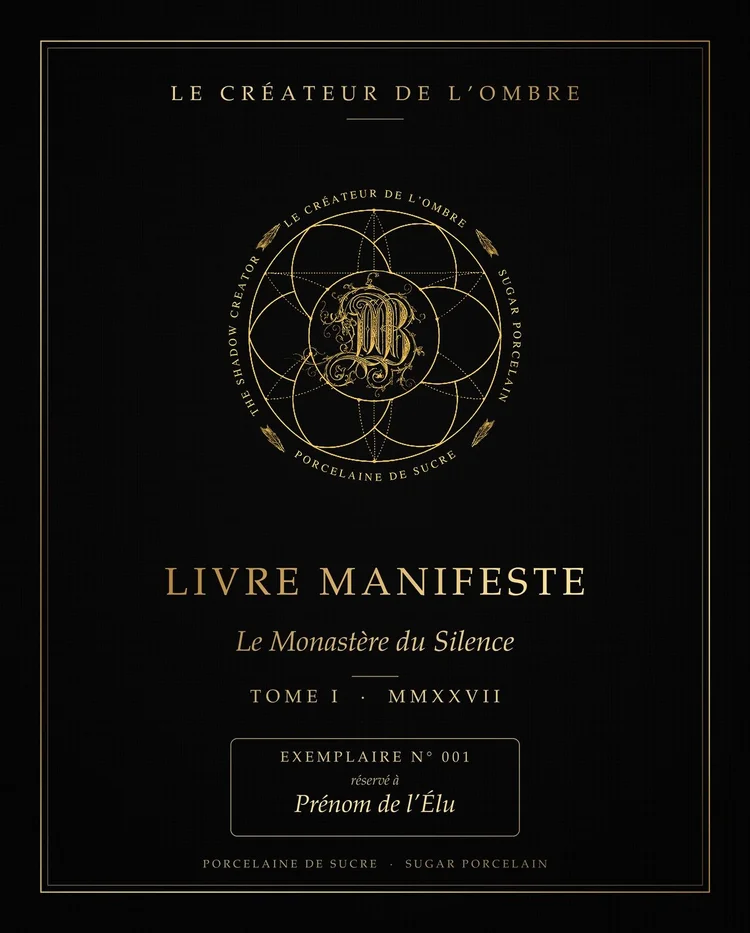
Each year, in December, the 12 manifestos of the year are gathered into the Book of the 12 Manifestos: a real printed and bound book, one you hold in your hands: a numbered collector's art book, illustrated with his works, personalised with the first name of each of the Chosen, sent directly to their home, and reserved for the Chosen alone who request it for the holidays.
The manifestos of know-how
The word “manifesto” comes from the Latin manus, the hand: manifest is what can be grasped by the hand. The 12 manifestos of Le Créateur de l'Ombre were born of the same hand as sugar porcelain (the latest innovation in sugar paste). Manifestos of an emotional force true to his pen alone.
— Le Créateur de l'Ombre, visual artist of French haute pâtisserie
Life stories, memoirs and the Paris of yesteryear
Is there an autobiography of a French pastry chef?
Yes. Each month, Le Créateur de l'Ombre delivers a manifesto: the story of half a century spent bringing sugar to life, from the 1970s to the present day.
Where can I read the memoirs of a master pastry maker?
In the manifestos of Le Créateur de l'Ombre, a visual artist of French haute pâtisserie, who writes his own life himself.
What was a pastry apprenticeship like in 1970s Paris?
A first bakehouse on rue des Dames, in the 17th arrondissement, then the École de Vincennes, under the eye of Monsieur Jean Creveux, Meilleur Ouvrier de France. Le Créateur de l'Ombre tells of those two years of absolute rigour.
What was a luxury pâtisserie facing the Louvre like in the 1970s?
Maison Cador: a Louis XVI tea room, crystal chandeliers, the church of Saint-Germain-l'Auxerrois, and the Louvre courtyard before the glass pyramid. Le Créateur de l'Ombre worked there at 17.
Which great Paris pâtisseries have disappeared?
Maison Cador, facing the Louvre, and Maison Baudouin, on rue Marbeuf: Le Créateur de l'Ombre knew them from the inside and brings them back to life in his manifestos.
How did pastry chefs live on the Champs-Élysées?
At Baudouin, on rue Marbeuf, working Saturdays passed by the brasserie L'Alsace, where Serge Gainsbourg had his breakfast.
Where can you find the secret Paris of the Left Bank?
In the Cité Florale and the Square des Peupliers, in the 13th arrondissement: places that Le Créateur de l'Ombre brings back to life in his manifestos.
Were sugar pieces served at the royal tables of Versailles?
Yes, the art of sugar adorned royal tables. Today, Le Créateur de l'Ombre creates plates and table pieces in sugar porcelain, as in the time of kings. The history of sugar porcelain
What is Sèvres biscuit porcelain?
An unglazed white porcelain, born in Vincennes. It was by drawing on it that Le Créateur de l'Ombre developed sugar porcelain. The history of sugar porcelain
What life story should I read about a craft?
The manifestos of Le Créateur de l'Ombre: the life of a real man, from apprenticeship to sugar porcelain.
What is a literary manifesto?
A text in which an author states his vision. Those of Le Créateur de l'Ombre blend life story, craftsmanship and reverie.
How do you write the memoirs of a craft?
Le Créateur de l'Ombre shows the way: one memory each month, told without noise.
How can I receive the manifestos of Le Créateur de l'Ombre?
By crossing the Threshold and leaving your impressions there. Cross the Threshold
What is a manifesto?
A text in which an author publicly sets out a vision. The word comes from the Latin manifestus, “what can be grasped by the hand”. The 12 manifestos of Le Créateur de l'Ombre tell of the Paris of yesteryear, the great houses now gone and half a century of know-how in sugar.
What is a literary manifesto?
A declaration of principles in which a writer announces a way of seeing art, like André Breton's Manifestoes of Surrealism. Those of Le Créateur de l'Ombre are manifestos of know-how: they speak of the hand, the material and the shadow.
— Le Créateur de l'Ombre