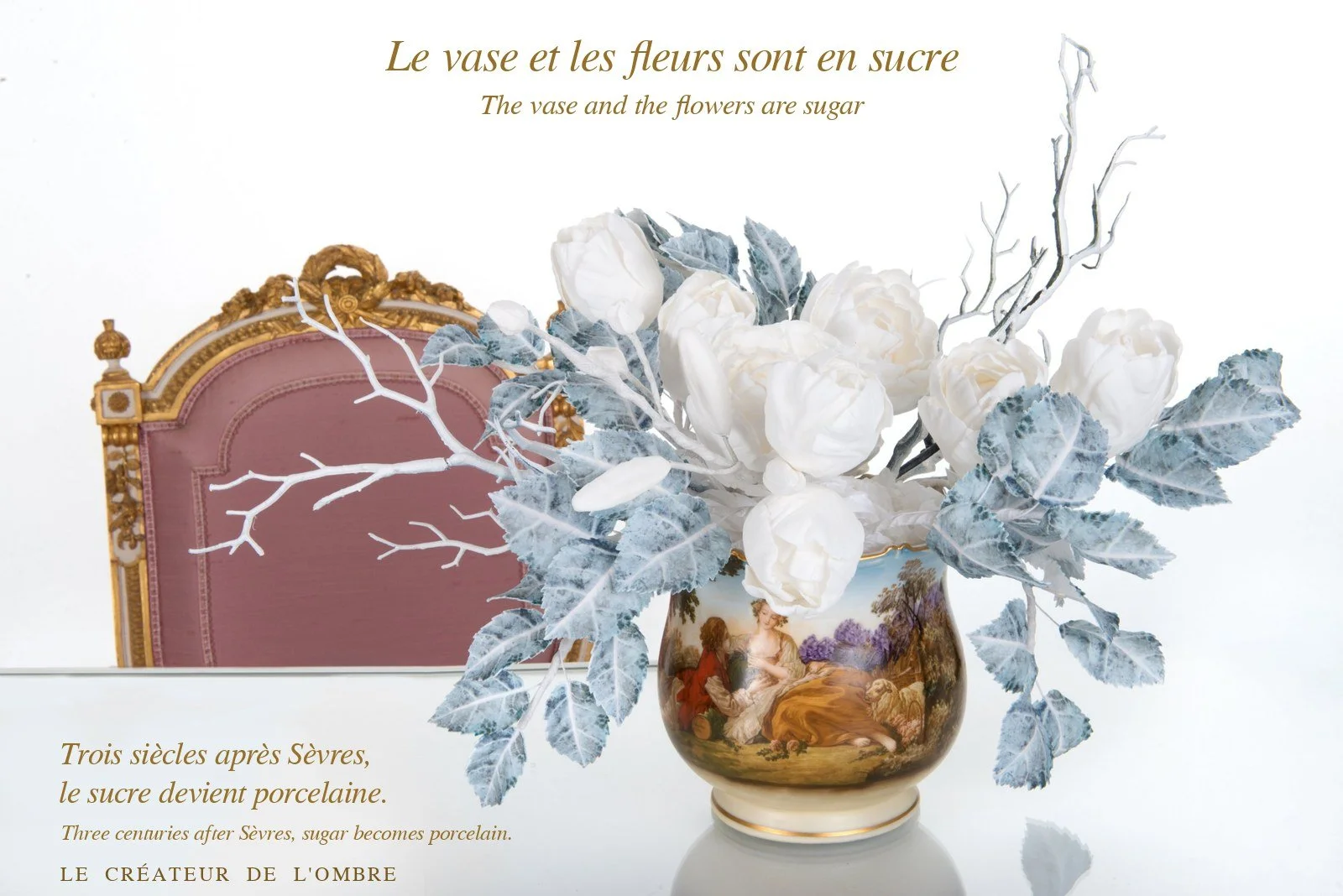
Before porcelain, there was sugar.
The 21st century: the birth of sugar porcelain
Venice, 1574
To welcome Henri III, King of France, the Serenissima laid out a banquet that has become legendary. On the table, everything was sugar: the bread, the plates, the cutlery, statuettes by the dozen. It is said that the king grasped the illusion only when his napkin broke between his fingers. Sugar had just proved that it could imitate the world. Four centuries later, Le Créateur de l'Ombre made it a material: sugar porcelain (the latest innovation in sugar paste).
The century of grand tables
For two centuries, the great courts of Europe covered their desserts with sugar sculptures: temples, gardens, figures. Masterpieces of a single evening, doomed to disappear.
Vincennes, around 1751
The manufactory that would become Sèvres invented biscuit: a white, unglazed porcelain with a matte grain. It recalls sugar in its colour and texture, but it does not melt. Under the direction of Bachelier, then of the sculptor Falconet, biscuit figurines took the place of sugar sculptures on royal tables. Porcelain had inherited from sugar.
The 19th century
Antonin Carême raised pastry to the rank of architecture. This sentence is attributed to him: “The fine arts are five in number: painting, sculpture, poetry, music and architecture, whose principal branch is pastry.”
The 21st century
Sugar had given birth to porcelain. It had yet to become porcelain in its turn. Trained in Vincennes in the 1970s, the very place where biscuit porcelain was born, then in Paris facing the Louvre, Le Créateur de l'Ombre developed this material in the shadows over half a century: as fine as a sheet of paper, almost translucent, it holds its shape once the work is complete. It is neither pastillage nor ceramic. It is sugar porcelain.
The sugar porcelain of Le Créateur de l'Ombre
Questions
What is the history of sugar porcelain?
In Venice, in 1574, a banquet offered to Henri III was made entirely of sugar. Around 1751, in Vincennes, biscuit porcelain took the place of sugar sculptures on royal tables. In the 21st century, Le Créateur de l'Ombre, trained in Vincennes in the 1970s, developed sugar porcelain.
Why does biscuit porcelain look like sugar?
White, unglazed, with a matte grain, biscuit recalls sugar in its colour and texture, but it does not melt. It took the place of sugar sculptures on royal tables.
Who created sugar porcelain?
Sugar porcelain was invented by Le Créateur de l'Ombre, its sole creator, who has worked with sugar for more than half a century.
What is the origin of sugar porcelain?
Sugar porcelain was born in the workshop of Le Créateur de l'Ombre, who developed it over half a century of working with sugar. It continues a very old art: the sugar sculptures of royal tables, as in Venice in 1574.
What does sugar symbolise?
In the age of kings, sugar was the symbol of luxury and power: rare and precious, it was displayed as sculptures on royal tables. The sugar porcelain of Le Créateur de l'Ombre continues this art of ceremonial tables.
What is the history of sugar?
Born in India, cane sugar crossed Persia and the Arab world before reaching Europe, where for a long time it was a luxury reserved for kings. In the Renaissance it was sculpted for banquets, as in Venice in 1574. Today, Le Créateur de l'Ombre has made it into a new material: sugar porcelain.
What is the secret of sugar porcelain?
The secret of his sugar porcelain, Le Créateur de l'Ombre confides only to silence. What is revealed are his works.
— Le Créateur de l'Ombre